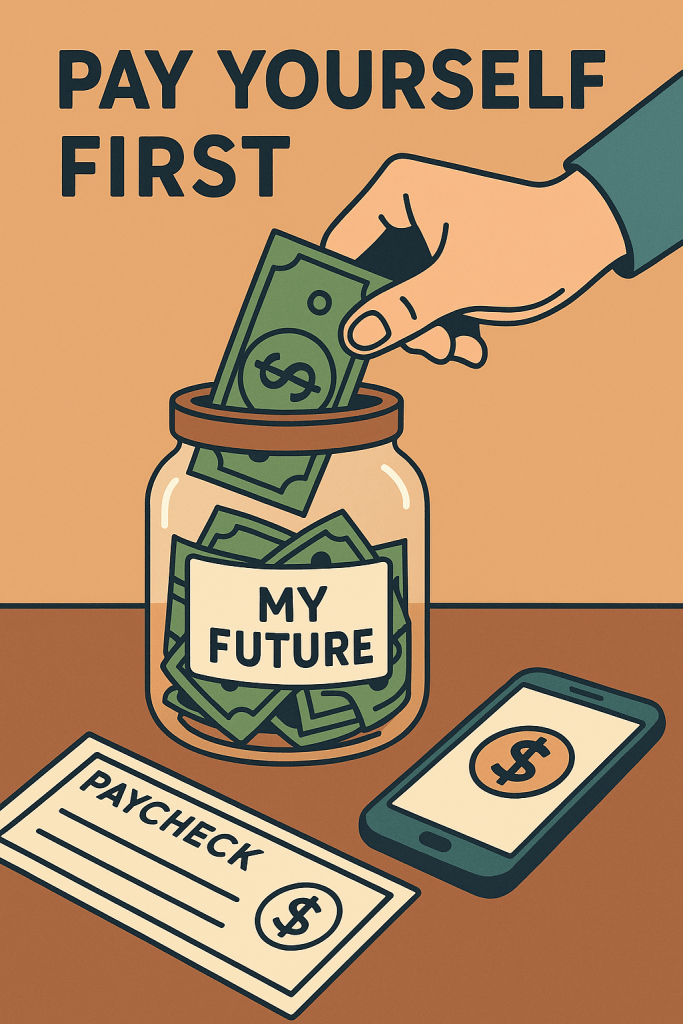
What if one small change to your money routine could transform your financial life — without requiring any budgeting, stress, or willpower?
That’s the power of the “Pay Yourself First” strategy.
It’s simple: when money comes in, you save first, and spend what’s left — not the other way around.
💡 What Does “Pay Yourself First” Mean?
Instead of saving what’s left after spending, you prioritize saving immediately when you receive income. This means:
- Saving happens automatically
- Your financial goals come before lifestyle spending
- You train your brain to live on less — without feeling restricted
🔗 Want to save more effectively? Read: The Ultimate Guide to Saving Money
🧾 How to Start Paying Yourself First
1. Decide Your Savings Rate
Start with 10% of your income — or as much as you can. Even 5% builds momentum.
2. Automate It
Set up automatic transfers to:
- Savings accounts
- Emergency fund
- Retirement accounts (like IRAs or 401(k)s)
- Investment platforms or robo-advisors
3. Treat It Like a Bill
Never skip it — just like you wouldn’t skip rent or your phone bill.
4. Adjust Over Time
As your income grows or expenses drop, increase your savings rate.
🔗 Need tools? Try these Budgeting Apps to Take Control of Your Finances
🏦 Where Should the Money Go?
- Emergency fund: 3–6 months of expenses
- Retirement accounts: Roth IRA, 401(k), or local equivalent
- High-yield savings account: For short- and mid-term goals
- Investments: ETFs, index funds, or robo-advisors
🔗 Not sure how to start saving? Begin with How to Build an Emergency Fund
🔁 Why It Works
✅ Behavior over budgeting: Builds financial stability without micromanaging every expense
✅ Invisible savings: Money moves before you see it — less temptation to spend
✅ Builds wealth automatically: Compounding starts working sooner
✅ Reduces decision fatigue: No need to “decide” to save each month
🧠 Real-Life Example
Let’s say you earn $3,000/month.
- You set an automatic transfer of $300 to savings on payday
- You budget the remaining $2,700 for bills, spending, and other goals
After 12 months, you’ve saved $3,600 — without even thinking about it.
🔗 Combine this with Zero-Based Budgeting for total financial clarity
⚠️ Common Mistakes to Avoid
- Saving only what’s left over (you’ll rarely have much)
- Not automating the process
- Using your savings for non-emergencies
- Skipping months when things get tight — consistency is key
🚀 Final Thoughts
Paying yourself first is the foundation of smart personal finance. It’s not about restriction — it’s about prioritization. When you put your future first, you’re not just saving money — you’re buying freedom.
Even if you start small, this habit will grow with you — and over time, build wealth quietly and powerfully in the background.
🔗 Want to build wealth on any income? Read: Building Wealth on Any Income

 Smart Finance Hub
Leave a reply to Sinking Funds: The Budgeting Trick That Prepares You for Big Expenses Without Stress – Smart Finance Hub Cancel reply