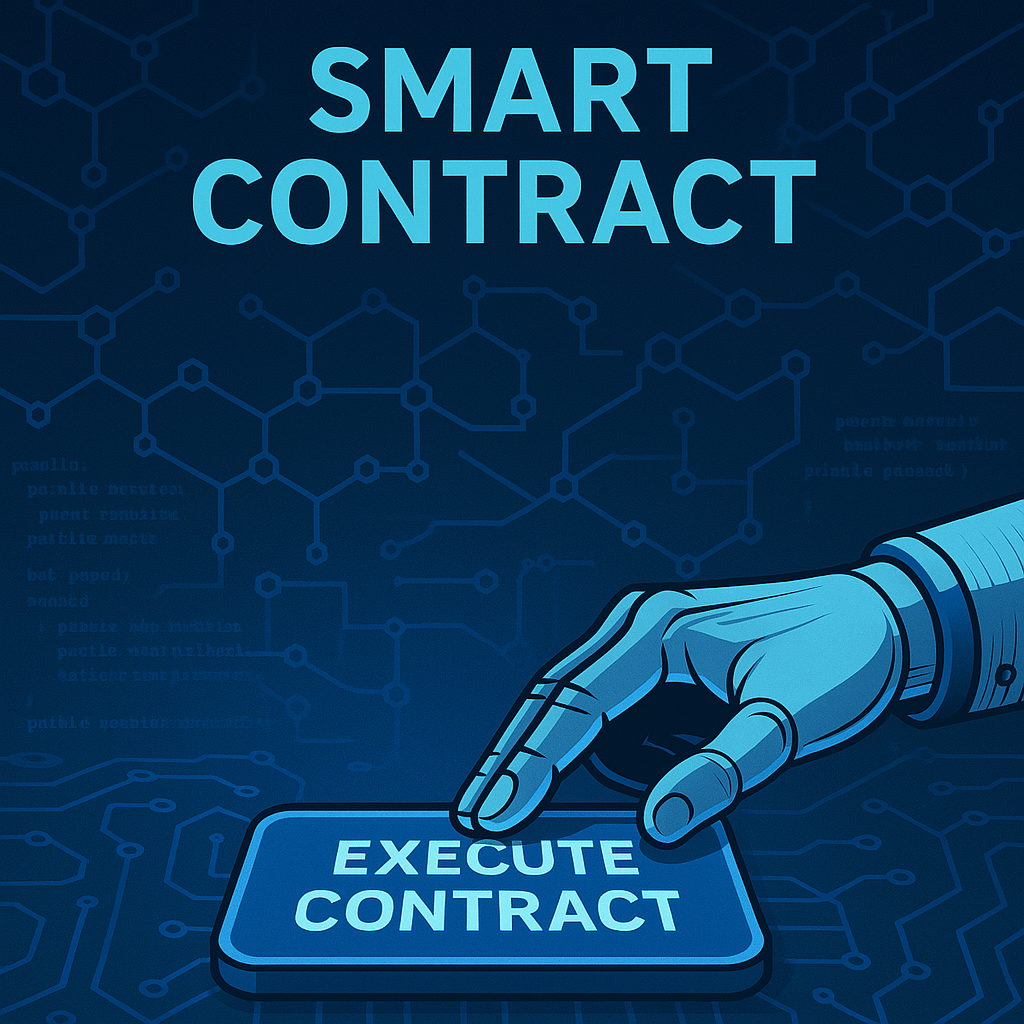
In traditional finance or legal systems, agreements rely on intermediaries — banks, lawyers, notaries. In crypto, a new paradigm emerged: smart contracts — self-executing code that automates transactions on the blockchain.
They are the backbone of DeFi, NFTs, DAOs, and many decentralized apps (dApps). But what exactly are they, and why are they such a big deal?
🤔 What Is a Smart Contract?
A smart contract is a digital agreement that runs automatically on a blockchain when predefined conditions are met. Once deployed, it cannot be altered, making it secure, transparent, and trustless.
Think of it like:
“If condition X happens, then execute action Y — without needing a third party.”
Example: “If Alice sends 1 ETH to a contract, the contract sends her a unique NFT.”
🔧 How Smart Contracts Work (In Simple Terms)
- Code is written (usually in Solidity for Ethereum).
- Contract is deployed to the blockchain.
- It listens for triggers (user actions, data from oracles, etc.).
- If conditions are met, the contract automatically executes the action (e.g., transfer funds, mint tokens, update a record).
🔗 Curious how this powers DeFi? Read What Is DeFi? A Beginner’s Guide
🌐 Real-World Applications of Smart Contracts
🏦 DeFi Platforms
Automate lending, borrowing, and yield farming without banks.
🎨 NFTs
Control minting, ownership, royalties, and transfers on marketplaces like OpenSea.
🏛️ DAOs
Enable voting and governance with no central authority.
📈 Token Sales
Facilitate secure token distributions in ICOs or IDOs.
📜 Digital Identity
Manage credentials and access rights on-chain.
🔗 Want to understand DAOs better? See What Are DAOs?
🛡️ Why Smart Contracts Matter
- Trustless: You don’t need to trust the other party — just the code.
- Immutable: Once deployed, it can’t be changed or manipulated.
- Transparent: Anyone can verify the contract and its actions.
- Efficient: No paperwork, delays, or middlemen.
🔗 Learn how to protect your assets in Crypto Security Tips
⚠️ Risks and Limitations
- Code Bugs: A smart contract is only as good as its code. Exploits can lead to hacks (e.g., the DAO hack in 2016).
- Gas Fees: Complex contracts can be expensive to execute on Ethereum.
- No Reversals: If a contract is flawed or exploited, there may be no way to recover lost funds.
🧠 The Future of Smart Contracts
- Layer 2 scaling (e.g., Arbitrum, Optimism) is making contracts faster and cheaper.
- Cross-chain compatibility will enable contracts to work across multiple blockchains.
- AI + Smart Contracts is an emerging trend for more adaptive automation.
🔗 Learn how scalability improves contracts in Layer 2 Solutions
🚀 Final Thoughts
Smart contracts are not just a feature of blockchain — they are the engine of Web3 innovation. They automate trust, create unstoppable code, and open up a world of decentralized applications that operate without gatekeepers.
Whether you’re investing in DeFi, trading NFTs, or participating in a DAO — you’re already using smart contracts.
🔗 Still learning the basics? Start with our Introduction to Cryptocurrency

 Smart Finance Hub
Leave a comment